
20 Jun Tree Felling: A Complete UK Guide
Tree felling is one of the most demanding and potentially hazardous tasks in arboriculture. Whether you are managing a diseased specimen in a domestic garden or clearing land ahead of a commercial project, understanding the process from start to finish is essential for safety and efficiency. This guide walks you through the key stages of tree felling in the UK, from initial hazard assessment through to post-felling clean-up, and explains why professional expertise often makes all the difference.
What Is Tree Felling?
Tree felling refers to the deliberate cutting down of a standing tree at or near its base. It differs from other tree surgery operations such as pruning, crown reduction, or pollarding, in that the objective is to remove the tree entirely. The reasons for felling vary widely. A tree may pose a safety risk due to disease or structural instability, it may be obstructing a development site, or it may simply have outgrown its environment.
In the UK, tree felling is subject to regulation under several pieces of legislation, and in many cases a licence or planning permission is required before work can begin. Trees protected by a Tree Preservation Order (TPO) or located within a conservation area require consent from the local planning authority before any felling can take place. You can find detailed guidance on TPO consent requirements through the Planning Portal.
Hazard Assessment: The Essential First Step
Before any chainsaw is started, a thorough hazard assessment must be carried out. The Health and Safety Executive (HSE) recognises tree felling as one of the most dangerous activities in Britain, and this stage must never be rushed.
The tree itself
Inspect the tree carefully for signs of decay, disease, or structural weakness. Look for splits in the bark, fungal growth at the base, dead wood in the canopy, and any notable lean. A heavy lean in one direction will directly influence how and where the tree falls, and must be factored into your felling plan before any cuts are made.
Overhead hazards
Dead branches lodged in the canopy, commonly referred to as "widowmakers", represent a serious risk. These can dislodge during felling operations and fall without warning. Any dead wood spotted overhead should be identified and dealt with before felling work begins.
Springpoles and tension
Bent or stressed stems under tension are known as springpoles. If cut incorrectly, these can whip back with extreme and sudden force. Identifying these during your hazard assessment is critical to avoiding serious injury.
Surrounding environment
Consider the proximity of structures, fences, overhead cables, roads, and bystanders. Identify a clear fall zone and ensure it is free of obstructions. Always establish at least two escape routes at approximately 45 degrees to the rear of the intended fall direction, and keep these clear throughout the operation.
Chainsaw Safety and PPE
Chainsaws are powerful, unforgiving tools, and proper use begins with the right personal protective equipment (PPE). The HSE sets out clear requirements for chainsaw PPE, which you can review on their dedicated guidance page. Required PPE includes:
- A chainsaw safety helmet with integrated visor and hearing protection
- Chainsaw-resistant trousers or chaps
- Chainsaw safety boots or chainsaw gaiters
- Cut-resistant gloves
- A high-visibility vest where required
Beyond PPE, the chainsaw itself must be properly maintained before every use. A well-maintained saw with a sharp, correctly tensioned chain cuts more predictably and places less physical strain on the operator. Before starting, check chain tension, oil levels, the air filter, and all safety features including the chain brake and throttle lock.
All personnel carrying out chainsaw operations professionally in the UK are expected to hold nationally recognised certification. Lantra Awards and NPTC qualifications represent the industry standard for chainsaw operation and tree surgery work. At Bailey Bros Tree Services, all our staff hold NPTC certification relevant to the work they carry out, so you can have full confidence in the competence of every operative on site.
Tree Felling Techniques
Once hazards have been assessed, PPE is in place, and the fall zone is secured, felling can begin. The direction of fall should be chosen based on the tree's natural lean, the prevailing wind direction, and the available clear space.
The undercut (or face notch)
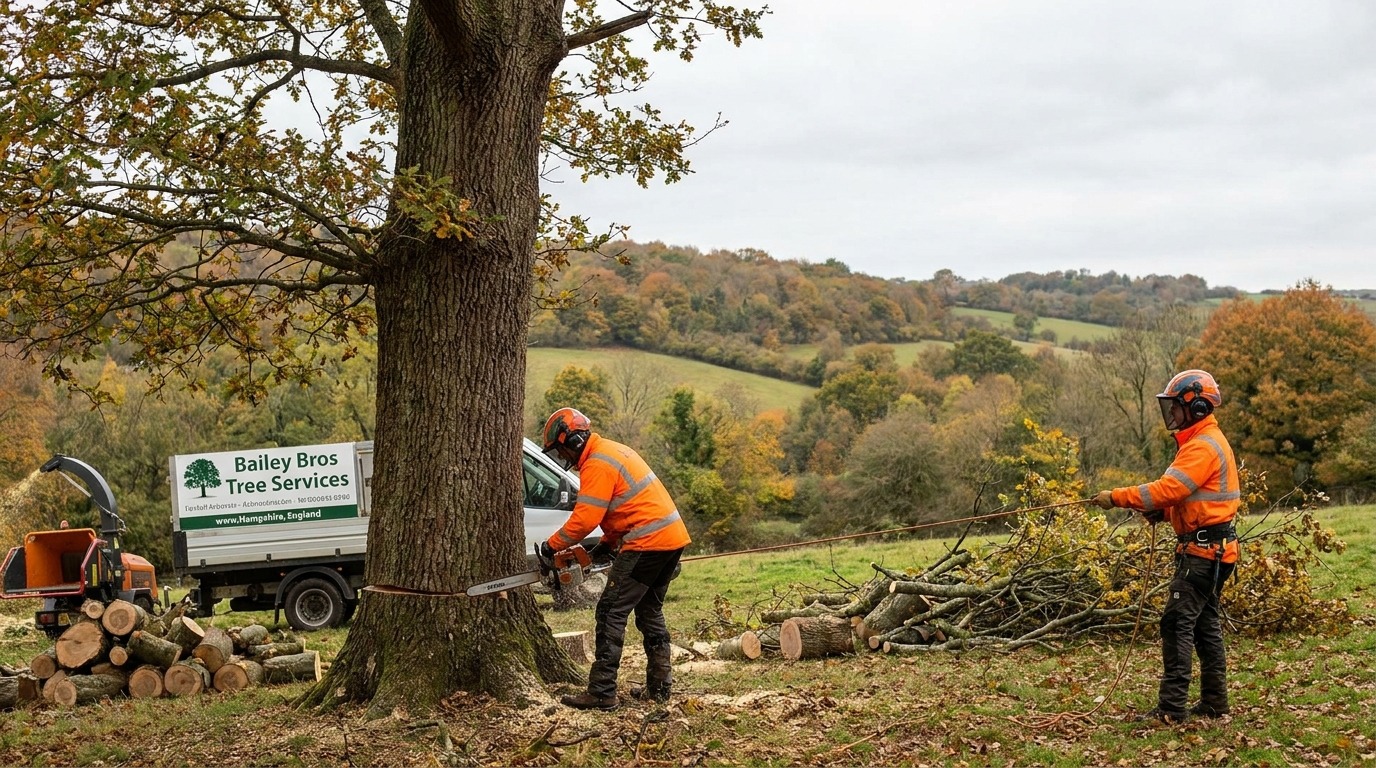
The first cut is the undercut, sometimes called the face cut or notch. This is made on the side of the tree facing the intended direction of fall, and consists of two cuts that meet to remove a wedge of timber from the trunk. The notch controls the direction of fall and creates a hinge that steers the tree as it comes down. As a general rule, the notch should be cut to approximately one-fifth of the trunk's diameter in depth.
The back cut
The back cut is made on the opposite side of the trunk, positioned slightly above the base of the notch. This cut releases the tension in the wood and initiates the fall. It is essential to leave a narrow strip of uncut wood between the back cut and the notch, known as the "hinge". The hinge is what guides the direction of fall, so maintaining it at a consistent, even width throughout the cut is critical. As the tree begins to move, the operator should immediately step back along one of the pre-planned escape routes, keeping eyes on the falling tree at all times.
Felling aids
For larger or more complex trees, felling wedges are often used. These are driven into the back cut to prevent the saw from becoming pinched and to assist in directing the fall. A felling bar or lever may also be used to apply additional force where the natural lean or weight of the tree requires it.
Post-Felling Operations: Limbing and Bucking
Once the tree is on the ground, the job is far from over. Two important post-felling operations follow: limbing and bucking.
Limbing
Limbing is the removal of branches from the felled trunk. This should be carried out methodically, working from the base of the tree toward the crown. Particular care must be taken with branches that are under compression or tension, as these can kick back with considerable force when cut. Where possible, always stand on the opposite side of the trunk from the branch being removed.
Bucking
Bucking is the process of cutting the limbed trunk into manageable sections. Understanding where a log is under compression or tension before cutting is essential. Cutting into the wrong side of a stressed log can cause the saw bar to become pinched, or the wood to split in an unpredictable direction. Work methodically, maintain a stable footing, and keep bystanders well clear throughout the entire process.
TPO Trees and Conservation Areas
If the tree you need to fell is protected by a TPO or sits within a conservation area, you will need consent from your local planning authority before any work can take place. This is an area where many homeowners understandably feel uncertain. We handle TPO applications on behalf of our clients, and if you subsequently proceed with the agreed works, the application is included free of charge. It is one less thing to worry about, and we will guide you through the process from the outset.
For a helpful overview of what a TPO means for your tree, the Royal Horticultural Society provides a clear and accessible explanation of the protections involved.
Green Waste and Post-Felling Tidy-Up
Responsible management of the material produced during felling is an important part of a professional operation. At Bailey Bros Tree Services, we recycle all green waste generated from our work. Wood is processed into logs, and chippings are turned into mulch used as biomass, so nothing produced on site goes to waste. If you are looking for quality firewood, take a look at our logs for sale, or visit our site clearance page to find out more about how we manage larger clearance projects.
Why Professional Tree Felling Matters
Tree felling is not a task to take lightly, even for those with some experience. Unexpected hazards, difficult access, or trees in confined spaces can all significantly raise the level of risk involved. Bailey Bros Tree Services operates to the highest professional standards, with all tree works completed in line with BS3998 recommendations and every operative holding NPTC nationally recognised certification. We are fully insured, carrying £10 million public liability cover, giving both domestic and commercial clients complete peace of mind.
One of our customers reflected on a recent job involving a tree in a particularly tight spot: "David and Peter were a great team. We had been very anxious about the work as the tree was in a confined area, but they did an excellent job on what was a very hot day. We would not hesitate to recommend them."
That reassurance is something we hear regularly, and it speaks to the care and professionalism our team brings to every project, regardless of scale or complexity.
Whether you have a single hazardous tree in your garden or require felling as part of a broader grounds management programme, we offer free estimates with no obligation. Browse our full range of tree and hedge services, or take a look at our project gallery to see completed work for yourself. When you are ready to take the next step, get in touch with us and we will be happy to help.
Sorry, the comment form is closed at this time.